

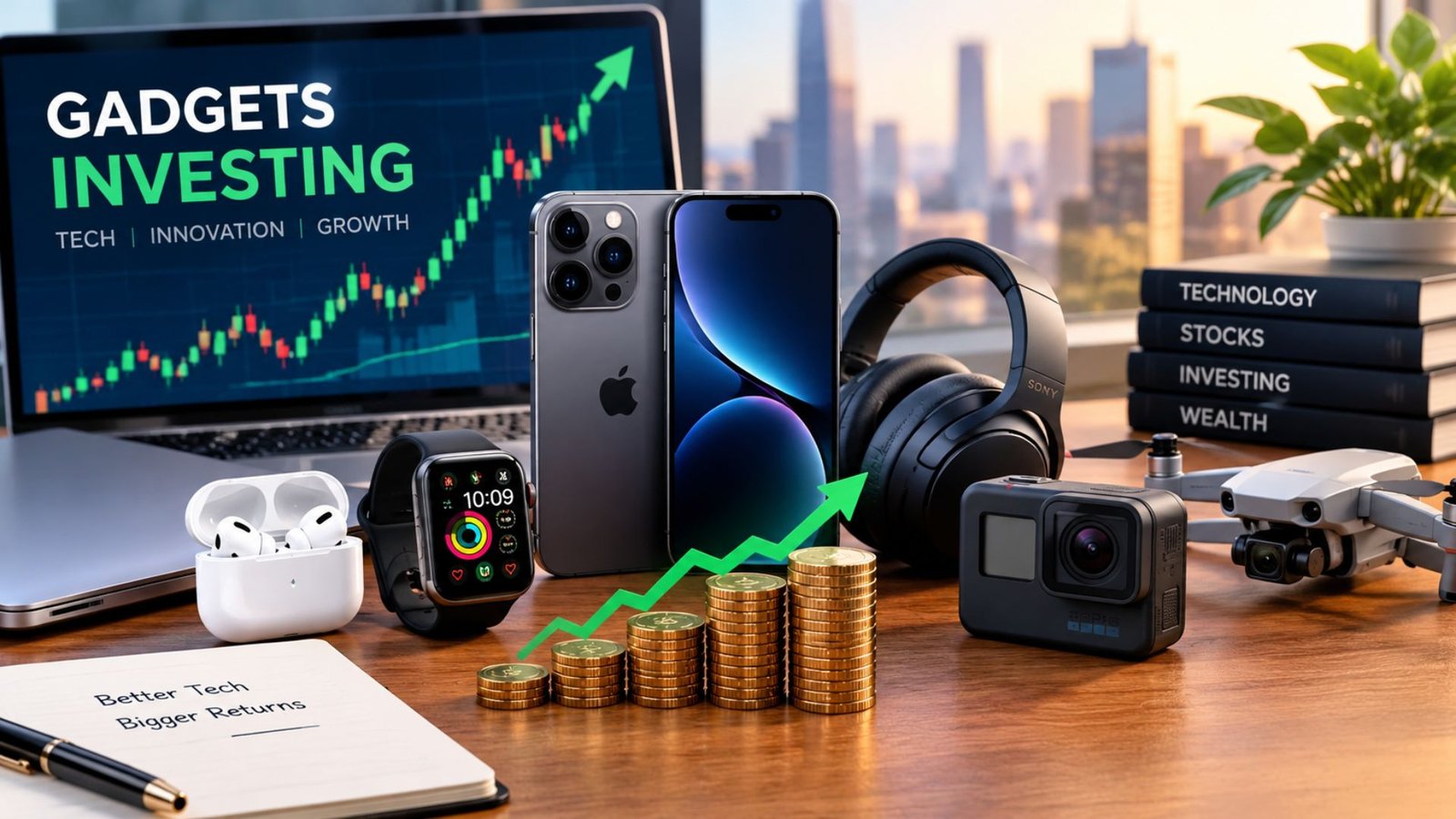
The phrase gadgets investing can describe two very different ideas: putting money into companies that manufacture or enable consumer technology, or buying physical devices in the hope that they become more valuable.
The distinction matters. Smartphones, laptops, wearables, gaming hardware, smart-home products, and other electronics are usually consumer purchases rather than financial investments. Most lose value as newer models arrive. Investing in the businesses, technologies, and supply chains behind those products is a different proposition, with opportunities as well as financial risk.
For investors in the USA and UK, understanding that difference is the best place to start.
What Does Gadgets Investing Actually Mean?
In practical terms, gadgets investing can take several forms.
An investor might buy shares in a company that designs smartphones, processors, wearables, cameras, gaming systems, or other electronics. Another person might invest through an exchange-traded fund that provides exposure to technology companies. Some buyers instead collect discontinued electronics, while others financially support unreleased products through crowdfunding platforms.
These approaches should not be treated as interchangeable.
A share represents an ownership interest in a business. Physical electronics provide ownership of the device itself. Reward-based crowdfunding can provide access to a future product but generally does not provide equity.
Kickstarter specifically states that backing a project is not the same as investing in a company and that backers do not receive ownership or equity.
Why Consumer Technology Attracts Investors
Consumer technology remains a huge commercial market, but growth does not move evenly across every category.
NIQ’s September 2026 outlook forecasts global technology and durable-goods sales of approximately $1.4 trillion for 2026. Its research also found that consumers have become increasingly selective, with durability, quality, convenience, and long-term value playing major roles in purchase decisions.
That creates an important lesson for gadgets investing: an exciting product does not automatically create an attractive investment.
Companies must convert technological innovation into sustainable revenue, margins, repeat purchases, services, or other competitive advantages.
Artificial intelligence is also influencing the hardware sector. Deloitte’s 2026 industry outlook highlights rising demand for AI infrastructure, processors, data centers, edge devices, and other computing hardware, while noting challenges affecting areas such as PCs and smartphones.
Different Ways to Gain Exposure to the Gadget Industry
| Approach | What You Own | Main Opportunity | Main Risk |
|---|---|---|---|
| Individual technology stocks | Shares in one company | Direct exposure to business growth | Company-specific losses |
| Technology or semiconductor ETFs | Shares in a fund | Exposure to multiple companies | Sector concentration and market declines |
| Physical gadgets | The actual device | Use value or possible collectibility | Depreciation and obsolescence |
| Rare technology collectibles | Vintage or limited hardware | Potential collector demand | Low liquidity and uncertain valuation |
| Reward crowdfunding | A pledge or potential reward | Early access to new technology | Delay, failure, or non-delivery |
For many people exploring gadgets investing as a financial strategy, publicly traded businesses and regulated investment funds are more conventional investment vehicles than purchasing devices.
Individual Technology Companies
Buying individual stocks gives investors direct exposure to a particular company’s performance. That exposure can be attractive when a business has valuable intellectual property, strong demand, recurring revenue, or a durable competitive position.
It also concentrates risk.
A popular product can lose momentum surprisingly quickly. Competition, manufacturing problems, component shortages, regulatory changes, weaker consumer spending, or failed product launches may affect financial performance.
Technology and Semiconductor Funds
ETFs can provide exposure to multiple companies through one investment.
The U.S. Securities and Exchange Commission’s Investor.gov explains that many ETFs hold numerous companies and industries, although narrowly focused ETFs may still be highly concentrated. Investors should therefore examine a fund’s objectives, holdings, costs, and prospectus rather than assuming every ETF provides broad diversification.
💡 Pro Tip
Before investing in a technology fund, inspect its largest holdings. Two funds with different names may own many of the same major technology companies, leaving your portfolio more concentrated than it initially appears.
Can Physical Gadgets Be Good Investments?
Usually, consumer electronics depreciate.
New generations bring faster processors, improved batteries, longer software support, better cameras, and lower manufacturing costs. Older hardware can consequently become less desirable.
That does not mean every device becomes worthless.
Historically important computers, unopened consoles, unusual prototypes, limited editions, and discontinued products can attract collectors. Their prices, however, depend on condition, rarity, provenance, buyer demand, and authenticity.
Anyone considering physical devices as part of gadgets investing should therefore separate collecting from conventional portfolio investing. A collectible may appreciate, but there is no dependable cash flow and finding a buyer at the desired price can be difficult.
How to Evaluate a Gadget-Related Investment
Product enthusiasm should be followed by business analysis.
Start with the company’s revenue sources. Determine whether it depends heavily on one device or has multiple products, software subscriptions, services, licensing arrangements, or enterprise customers.
Then examine:
- revenue and earnings trends;
- operating margins and cash generation;
- debt and financing requirements;
- research and development spending;
- market share and competitive pressure;
- supply-chain dependence;
- product replacement cycles;
- valuation relative to expected growth.
Consumer behaviour deserves particular attention. NIQ reports that technology buyers are increasingly focused on products that justify their cost through practical value, performance, convenience, and durability.
A technically impressive product may therefore struggle commercially if customers see little reason to replace what they already own.
Major Risks Investors Should Consider
One weakness of gadgets investing is its exposure to rapid technological change. Today’s category leader can face a completely different competitive environment within a few product generations.
Valuation risk matters as well. A strong company can still be a poor investment if its market price assumes unrealistic future growth.
Sector concentration creates another issue. Owning smartphone, chip, software, and AI-related companies might look diversified, yet those businesses can still respond to similar economic conditions.
Investor.gov recommends spreading investments across assets and sectors as a way of managing overall portfolio risk, while emphasizing that diversification cannot eliminate losses.
Currency exposure may also affect UK investors purchasing US-listed securities, while taxes, account structure, brokerage charges, and fund fees can change net returns.
A More Disciplined Approach
Good research begins with a thesis rather than a product launch.
Ask what commercial problem the technology solves, how large its addressable market could be, who controls the underlying technology, and how the company makes money.
Then consider what could prove the thesis wrong.
For gadgets investing, particularly useful signals include replacement cycles, average selling prices, semiconductor demand, unit shipments, subscription growth, margins, inventory levels, and consumer willingness to upgrade.
Avoid assuming that popularity on social media translates directly into shareholder returns.
📌 Key Takeaway
Consumer gadgets themselves normally provide utility rather than predictable investment returns. Investors seeking financial exposure to technology should distinguish physical products from the businesses, funds, components, and infrastructure behind them while considering diversification, valuation, fees, and their own tolerance for loss.
Frequently Asked Questions
Is investing in gadgets profitable?
It can be, depending on what “investing” means. Shares in successful technology companies or funds can appreciate, but they can also decline. Physical electronics usually depreciate, while collectible devices have unpredictable values. No technology-related investment provides guaranteed returns.
Are technology ETFs safer than individual tech stocks?
An ETF can reduce company-specific risk by holding multiple securities, but it is not automatically low risk. A narrowly focused technology or semiconductor ETF may remain highly exposed to one sector. Investor.gov recommends checking a fund’s holdings and investment strategy before investing.
Can old smartphones or computers increase in value?
Some can, particularly rare, historically significant, unopened, or limited-production devices. However, most electronics lose value because technology improves rapidly. Collectibles also have uncertain demand and may take considerable time to sell.
Is crowdfunding a way to invest in new gadgets?
Not necessarily. On reward-based platforms such as Kickstarter, contributors generally back the creation of a project rather than purchase equity in the company. A campaign may experience production delays or other problems, so the platform’s terms should be understood before pledging.
What should beginners research before investing in technology?
Look beyond the gadget itself. Study the company’s financial performance, competitive position, valuation, revenue model, cash flow, product dependency, industry growth, and major risks. Also consider whether the investment fits your wider portfolio, time horizon, and risk tolerance.
Final Thoughts
Technology will continue producing new devices, platforms, processors, and consumer experiences, but innovation alone does not guarantee investment success.
A sensible gadgets investing strategy focuses on the economics behind the technology: who captures the revenue, whether demand is sustainable, how much growth is already reflected in the price, and what risks could undermine the opportunity.
Treat physical gadgets primarily as products unless there is a credible collectible market, and approach stocks or funds as financial assets that require independent research, diversification, and disciplined risk management.

1 Comment
Pingback: Local Radar: How to Read Weather Radar Near You - 80s Fashion Style