

Imagine sending a private message, storing your banking details online, or uploading personal files to the cloud. You probably assume that information stays private because you trust the service handling it. But as data travels between devices, networks, servers, and applications, there are several points where unauthorized people could potentially access it.
Encryption is one of the main technologies designed to prevent that from happening. It transforms readable information into an encoded form that cannot be meaningfully understood without the appropriate key. The same basic idea protects everything from online payments and passwords to private messages and business documents.
But encryption is not one single technology. Symmetric encryption uses the same secret key to encrypt and decrypt information, while other systems use separate public and private keys. End-to-end encryption takes the concept further by attempting to ensure that only the communicating endpoints can read the message.
Understanding these differences makes it much easier to judge whether an app, website, cloud service, or business system is genuinely protecting your information—or simply using the word “encrypted” as a reassurance.
What Is Encryption?
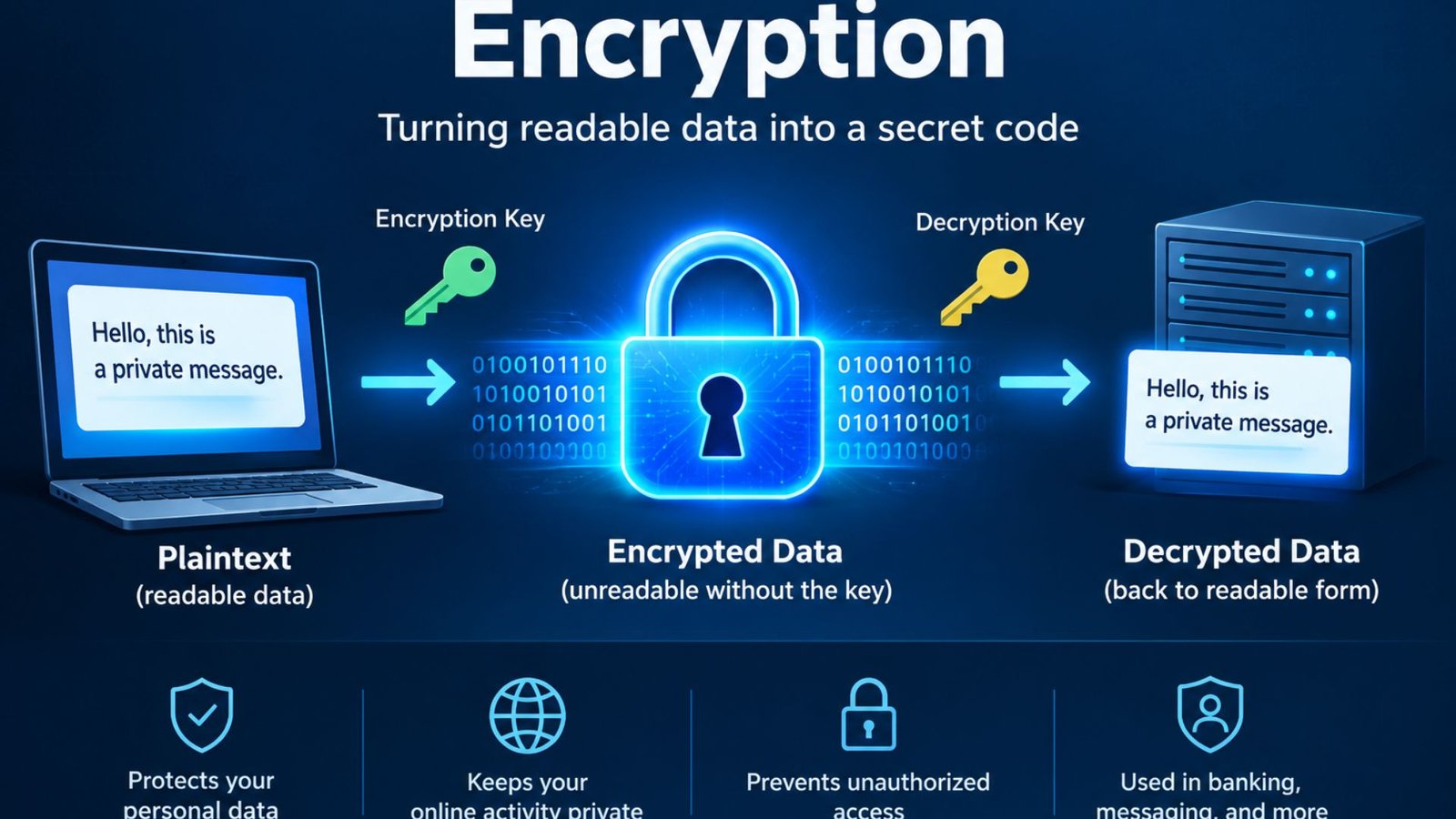
Encryption is the process of converting readable information, known as plaintext, into an unintelligible format called ciphertext.
A mathematical algorithm performs the transformation using a cryptographic key. Someone who does not have the appropriate key should not be able to turn the ciphertext back into useful information.
For example, imagine that you type:
“Meet me at 7 PM.”
After encryption, the resulting data may look like meaningless characters. If an attacker intercepts that data while it is being transmitted, they should not be able to simply read the original message.
The basic process looks like this:
Plaintext → Encryption algorithm + key → Ciphertext
When an authorized recipient needs the information, a corresponding decryption process converts it back into readable data.
Encryption is used in many everyday situations, including:
- Online banking
- E-commerce payments
- Messaging applications
- Wi-Fi connections
- Password managers
- Cloud storage
- Corporate networks
- Smartphone storage
- Virtual private networks
- Secure websites
The important point is that encryption protects data, but the strength of that protection depends on how the encryption system is designed and implemented.
What Is End-to-End Encryption?
If you have searched for what is end to end encryption, the simplest explanation is this:
End-to-end encryption (E2EE) is a communication method in which a message is encrypted on the sender’s device and is intended to be decrypted only on the recipient’s device.
The message remains encrypted while traveling between the two endpoints.
Consider a private conversation between Alice and Bob.
- Alice writes a message.
- Alice’s device encrypts it.
- The encrypted message travels across the internet.
- Servers may transport or temporarily handle the encrypted data.
- Bob’s device decrypts it.
- Bob reads the original message.
The crucial distinction is that the service transporting the message should not possess the keys needed to decrypt the conversation.
This is different from ordinary encryption in transit.
For example, HTTPS encrypts information traveling between your browser and a website. That is extremely useful, but the website itself can generally access the information after it reaches its server.
With properly implemented E2EE, the service is designed so that the provider cannot ordinarily read the protected conversation.
Why End-to-End Encryption Matters
Suppose you send a sensitive document through an online service.
If the document is encrypted only while traveling to the provider, it may be protected against network interception. However, the provider’s systems may still be able to process or access the decrypted content.
With E2EE, the design goal is different: the provider should not have the decryption capability in the first place.
That creates an important security boundary.
It also explains why E2EE can make certain features more difficult. If a provider cannot decrypt your messages, it cannot easily perform server-side searches, content analysis, moderation, or recovery of encrypted information.
How Does Symmetric Encryption Work?
Symmetric encryption uses the same secret key for both encryption and decryption.
Imagine putting a document inside a locked box. You use a particular key to lock it, and the recipient uses the corresponding secret key to unlock it.
The basic model is:
Plaintext + secret key → ciphertext
Then:
Ciphertext + same secret key → plaintext
Modern symmetric encryption is extremely fast, which makes it useful for protecting large amounts of information.
A widely recognized example is AES (Advanced Encryption Standard). AES can be used to protect files, databases, communications, storage systems, and other sensitive information.
The Main Problem With Symmetric Encryption
The biggest challenge is key distribution.
If Alice wants to send encrypted information to Bob using a secret key, both Alice and Bob need access to that secret key.
But how does Alice securely give Bob the key?
If she sends the key through an insecure channel, an attacker could intercept it. Once the attacker has the key, the encryption provides little protection against that attacker.
This is one reason modern cryptographic systems often combine different types of encryption instead of relying exclusively on symmetric encryption.
Symmetric vs. Asymmetric Encryption
The difference becomes easier to understand with a simple comparison.
| Feature | Symmetric Encryption | Asymmetric Encryption |
|---|---|---|
| Keys used | One shared secret key | Public and private key pair |
| Speed | Generally very fast | Generally slower |
| Main challenge | Secure key distribution | Private-key protection |
| Common role | Encrypting bulk data | Authentication and key exchange |
| Example | AES | RSA, elliptic-curve systems |
Asymmetric cryptography uses two related keys.
The public key can generally be shared. The private key must remain secret.
This solves an important distribution problem because someone can use a recipient’s public key as part of a cryptographic process without needing to receive the recipient’s private key.
In practice, modern systems often use asymmetric cryptography to establish trust or exchange a secret, then use fast symmetric encryption to protect the actual data.
That combination gives you the advantages of both approaches.
How Encryption Works in Everyday Life
You probably use encryption many times every day without thinking about it.
Online Shopping
When you enter payment information on a properly secured website, encryption helps protect information as it moves between your device and the service.
Smartphone Storage
Modern phones can encrypt stored information so that someone who obtains the physical device cannot simply browse through its contents.
Messaging
Some messaging systems use end-to-end encryption to protect conversations from unauthorized access while messages are being transported and stored.
Wi-Fi
Wireless security protocols use cryptographic mechanisms to prevent nearby unauthorized devices from simply reading network traffic.
Business Systems
Companies use encryption to protect employee information, customer records, financial documents, intellectual property, and backups.
The key lesson is that encryption can protect information both while it is moving and while it is stored, depending on how the system is designed.
Encryption at Rest vs. Encryption in Transit
Two phrases frequently appear in security discussions: encryption at rest and encryption in transit.
Encryption at rest protects stored information.
Examples include:
- Files stored on a laptop
- Database records
- Cloud storage
- Smartphone data
- Backup drives
Encryption in transit protects information while it moves between systems.
Examples include:
- Browser-to-website connections
- App-to-server communications
- Email transmission
- API connections
A system can use both.
However, neither automatically means that the data is end-to-end encrypted. E2EE is specifically concerned with who possesses the ability to decrypt the information at the endpoints.
A Common Mistake: Assuming “Encrypted” Means “Private”
This is one of the most important practical distinctions.
A company can truthfully say that your data is encrypted while still being capable of decrypting it.
For example, information might be encrypted when traveling from your device to the company’s server and encrypted again while stored on that server. Yet the company may retain the keys required to decrypt the data.
That is still valuable security.
It simply isn’t the same security model as end-to-end encryption.
When evaluating a service, ask:
- Is the data encrypted in transit?
- Is it encrypted while stored?
- Who controls the encryption keys?
- Can the provider decrypt the information?
- Are backups encrypted?
- Are messages encrypted on the device before transmission?
- What happens if an account is compromised?
These questions reveal considerably more than a generic “encrypted” label.
READ ALSO:TechCrunch Disrupt 2025: What Really Happened
Three Less-Obvious Insights About Encryption
Encryption Does Not Hide Everything
Encryption can protect the content of a communication without hiding all of its surrounding information.
Depending on the system, metadata such as communication times, account identifiers, device information, message sizes, or network addresses may still be visible.
That means a person can potentially learn something about a communication without being able to read its contents.
Key Management Can Matter More Than the Algorithm
People often focus on whether a system uses a particular encryption algorithm. In real deployments, however, poorly protected keys can undermine otherwise strong cryptography.
If an attacker obtains the key, mathematically strong encryption does not magically protect the information anymore.
Secure key generation, storage, rotation, recovery, and access control are therefore fundamental parts of practical encryption.
Encryption Can Create a Recovery Trade-Off
Strong encryption can make unauthorized access harder—but it can also make legitimate recovery harder.
If only the user possesses the keys and those keys are permanently lost, encrypted information may become unrecoverable.
This creates a real-world trade-off between security and convenience. A system designed for maximum privacy may intentionally make password or device recovery less powerful.
Common Encryption Mistakes to Avoid
Even strong encryption can be undermined by poor security practices.
Using Weak or Reused Passwords
A strong encryption system cannot compensate for an easily compromised account.
Use unique passwords and, where available, multifactor authentication.
Treating Encryption as a Complete Security Strategy
Encryption protects information from particular types of unauthorized access. It does not automatically protect against phishing, malware, stolen credentials, malicious applications, or an unlocked device.
Security requires multiple layers.
Confusing Hashing With Encryption
Hashing and encryption are not interchangeable.
Encryption is designed to be reversible with the appropriate key. Hashing generally produces a one-way representation used for purposes such as password verification and data integrity.
Ignoring Backups
A system may encrypt the primary copy of your data while leaving old backups poorly protected.
For businesses especially, backup security deserves the same attention as production systems.
How to Choose an Encryption System
If you’re evaluating an application or service, don’t stop at the word “encrypted.”
Look at the complete security model.
Ask:
- What data is encrypted?
- When is it encrypted?
- Who controls the keys?
- Can the provider decrypt it?
- How are keys stored and recovered?
- Are backups protected?
- What happens if an account or device is compromised?
For ordinary users, a service with strong encryption, good account security, secure device storage, and transparent documentation is generally a better choice than one that simply advertises encryption without explaining how it works.
For organizations, the evaluation should go further and include access controls, key management, audit procedures, backup protection, employee permissions, and incident response.
Frequently Asked Questions
What is end-to-end encryption in simple terms?
End-to-end encryption protects a communication so that the intended endpoints are designed to be the only places where the readable content is available. The message is encrypted before it leaves the sender’s device and decrypted when it reaches the recipient’s device. The service carrying the communication should not possess the keys required to read the protected content.
Is symmetric encryption secure?
Yes. Modern symmetric encryption can provide extremely strong protection when properly implemented with secure keys and appropriate algorithms. Its major practical challenge is securely sharing and managing the secret key. This is why modern systems often combine symmetric encryption with other cryptographic techniques.
What is the difference between encryption and end-to-end encryption?
Encryption is the broader concept of protecting information by transforming it into ciphertext. End-to-end encryption describes a particular security architecture in which the endpoints control the ability to decrypt the protected communication. A service can therefore use encryption without providing true end-to-end encryption.
Can encrypted data still be hacked?
Encryption itself can be very difficult to break when modern algorithms and strong keys are used correctly. However, attackers may target passwords, encryption keys, devices, applications, or implementation weaknesses instead of trying to break the underlying mathematics. In practice, the surrounding security system matters enormously.
Does encryption protect metadata?
Not necessarily. Encryption can protect the actual content of a message while leaving certain metadata visible, depending on how the system is designed. Information such as timing, account details, traffic patterns, or other connection data may remain accessible even when message contents are protected.
Conclusion
Encryption is much more than a technical feature hidden behind an app or website. It is a fundamental way of controlling who can access digital information.
Symmetric encryption provides fast and efficient protection using a shared secret key, while asymmetric cryptography helps solve problems involving identity and key exchange. End-to-end encryption goes further by designing communication so that the service carrying the information should not be able to read the protected content.
The most useful habit is to stop asking only, “Is my data encrypted?” Instead, ask where it is encrypted, who has the keys, and who can actually decrypt it.
That small shift in thinking makes it much easier to understand the privacy and security claims behind the digital services you use every day.
