

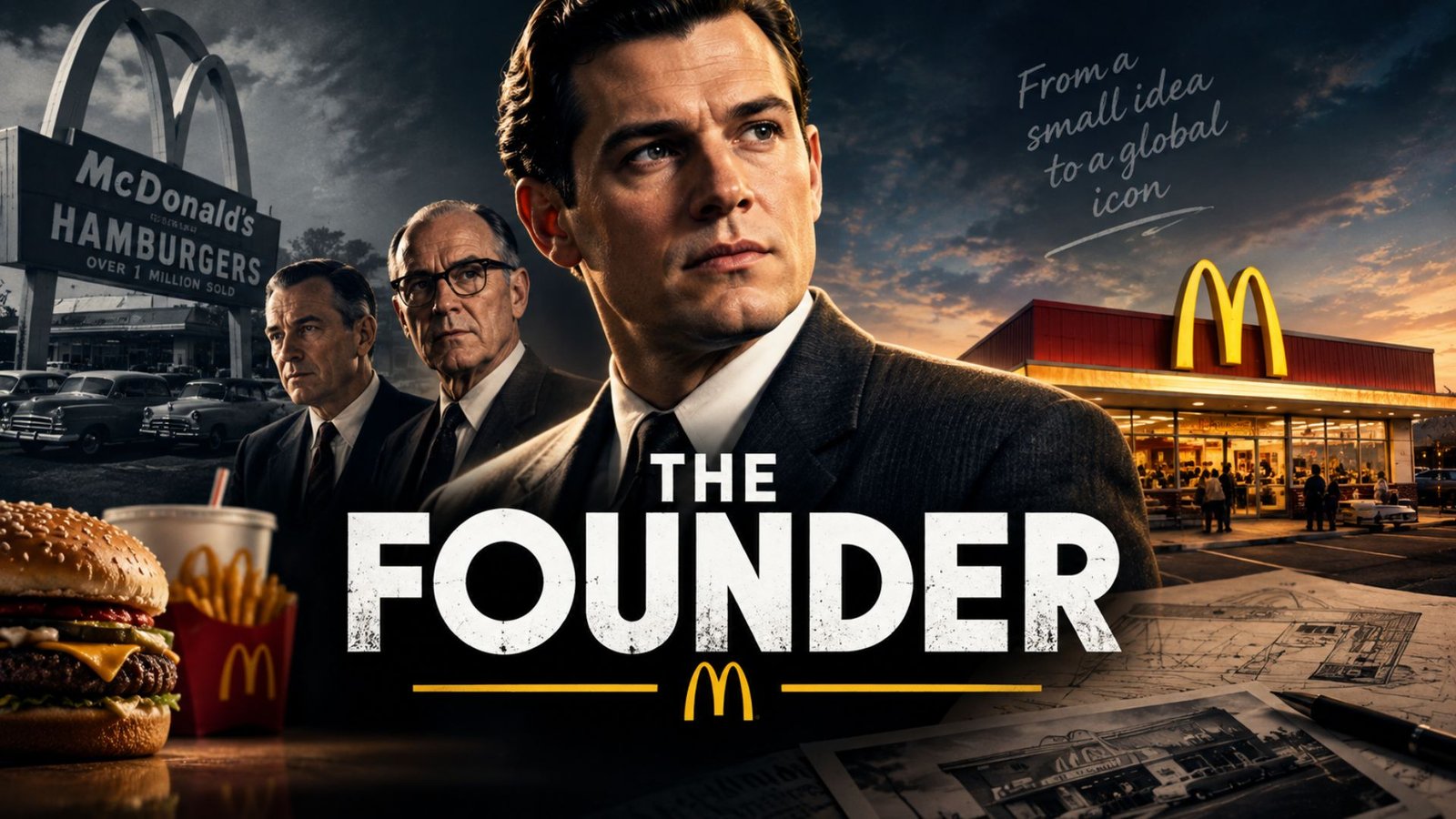
Finding a movie that is entertaining, based on real events, and genuinely useful for understanding business can be harder than it sounds. The Founder stands out because it is not simply a movie about hamburgers or the rise of McDonald’s. It is a story about opportunity, franchising, persistence, ownership, negotiation, and the complicated difference between creating an idea and scaling it.
Released in 2016, the film stars Michael Keaton as Ray Kroc, a struggling salesman who encounters Mac and Dick McDonald and recognizes the potential of their unusually efficient restaurant system. Directed by John Lee Hancock, the movie explores how that meeting eventually changes the trajectory of all three men.
If you are searching for the founder movie because you want to know where to watch it, what it is about, whether it is based on a true story, or whether it is worth your time, this guide covers those questions. More importantly, it looks at the business lessons hidden beneath the familiar McDonald’s story—and why some of them remain relevant to entrepreneurs today.
What Is The Founder Movie About?
The Founder is a biographical drama centered on Ray Kroc and his relationship with brothers Richard “Dick” McDonald and Maurice “Mac” McDonald.
The McDonald brothers operate a restaurant in 1950s Southern California that is very different from the traditional drive-in model of the era. Their system emphasizes speed, consistency, a limited menu, and an organized production process.
Kroc, a travelling salesman, becomes fascinated by the operation after seeing how efficiently the restaurant serves customers. Rather than viewing it simply as a successful local restaurant, he sees the possibility of replicating the model across the country.
That distinction drives much of the movie.
The brothers have created an efficient restaurant operation. Kroc becomes increasingly focused on expanding and franchising the concept.
The film follows the tension that develops as those different visions collide. It eventually becomes a story about control, contracts, real estate, branding, and the question of who gets to claim ownership of a business story.
Who Stars in The Founder?
Michael Keaton plays Ray Kroc, giving the central character a combination of charm, persistence, frustration, and ambition.
The principal cast includes:
- Michael Keaton as Ray Kroc
- Nick Offerman as Dick McDonald
- John Carroll Lynch as Mac McDonald
- Laura Dern as Ethel Kroc
- Linda Cardellini as Joan Smith
- B.J. Novak as Harry Sonneborn
- Patrick Wilson as Rollie Smith
Netflix and other major movie databases identify Keaton, Offerman, and Lynch among the film’s leading cast members.
The casting is particularly effective because the three central business personalities are presented differently. The McDonald brothers are focused on protecting a system they carefully developed, while Kroc increasingly thinks in terms of scale and opportunity.
Is The Founder Based on a True Story?
Yes. The Founder is based on the real history surrounding Ray Kroc and the McDonald brothers, although, like most dramatic films based on real events, it presents that history through a screenplay and dramatized scenes.
The basic premise is historical: Kroc encountered the brothers’ restaurant operation, became interested in its franchise potential, and eventually played a major role in transforming McDonald’s into a massive restaurant business.
One useful way to watch the film is to separate historical events from cinematic storytelling.
The movie is designed to create a coherent narrative, so conversations, timing, character interactions, and some dramatic moments should not automatically be treated as documentary evidence.
That does not make the business story less interesting. In fact, it makes the movie more useful when you watch it as a dramatized interpretation of a real entrepreneurial transformation.
Where Can You Watch The Founder?
Availability depends heavily on your country.
As of October 2026, JustWatch lists The Founder as available to stream on Netflix in the United States, while digital rental and purchase options include services such as Amazon Video and Apple TV.
In India, current listings show the movie available for digital rental or purchase through Apple TV rather than as a free streaming option.
There is an important practical point here: streaming catalogs change frequently because licensing agreements expire and move between services.
If you search for watch the founder, check the availability for your specific country rather than assuming that a platform listed in another country will carry the movie for you.
For example, Netflix’s Pakistan page currently indicates that the title is not available in that country.
How Long Is The Founder?
The movie runs for approximately 1 hour and 55 minutes.
That makes it long enough to develop the business story without turning into a multi-part biography.
If you are watching it specifically for its entrepreneurial lessons, it is worth paying attention to the restaurant scenes rather than focusing only on the major plot developments. Some of the most useful ideas appear in seemingly ordinary conversations about operations and expansion.
What Makes The Founder Different From a Typical Business Movie?
Many business movies concentrate on a breakthrough idea.
The Founder is more interested in what happens after someone recognizes a scalable system.
That is a major difference.
The McDonald brothers’ contribution is shown through operational efficiency. Their restaurant works because the process itself has been redesigned.
Kroc’s contribution, as portrayed by the movie, is his focus on expansion.
This creates an important business distinction:
Innovation and scalability are not always the same skill.
Someone can build an excellent product or business without having the same abilities required to distribute it widely. Conversely, someone skilled at scaling may recognize commercial potential in an idea created by somebody else.
The tension between those capabilities is one of the film’s central themes.
The Business Lesson Hidden in the Restaurant System
One of the most interesting aspects of the film is the attention given to process.
The McDonald brothers do not simply try to make better hamburgers. They rethink how a restaurant should operate.
Their approach involves:
- Simplifying the menu.
- Standardizing preparation.
- Reducing unnecessary movement.
- Assigning specific tasks.
- Increasing speed.
- Making the customer experience more predictable.
That lesson applies far beyond restaurants.
Imagine a small digital agency where every employee handles projects differently. Even if the team is talented, growth becomes difficult because quality depends heavily on individual behavior.
Now imagine documenting the workflow, defining responsibilities, standardizing onboarding, and creating repeatable quality checks.
The agency has moved from relying entirely on individual talent to building a system.
That is one of the most practical ideas viewers can take from the movie.
A Less-Obvious Lesson: Real Estate Can Change a Business Model
One of the film’s more important business developments involves real estate.
This is easy to miss because viewers naturally focus on the restaurants and hamburgers. But the movie demonstrates how the underlying economics of a business can change when the company controls valuable locations and uses them strategically.
This is a particularly useful lesson for modern entrepreneurs.
A company may appear to make money from one product while its long-term strength actually comes from an underlying asset, distribution system, platform, customer network, or recurring revenue structure.
For example, a software company might initially appear to sell software licenses. Its real competitive advantage could eventually become its customer ecosystem and recurring subscription base.
The product gets attention.
The underlying business model creates durability.
Another Overlooked Insight: Franchising Is About Consistency
Franchising sounds like expansion, but expansion alone does not guarantee a successful franchise system.
A franchise business must make its operating model reproducible.
If one location is excellent while another performs poorly, the brand suffers.
That means a scalable franchise concept needs things such as:
- Repeatable operating procedures
- Training systems
- Quality standards
- Supply consistency
- Brand guidelines
- Location strategy
- Financial controls
- Clear responsibilities between owners and operators
The Founder illustrates why this becomes difficult when the people involved have different ideas about how much control should be retained.
That is a useful lesson for anyone considering franchising today:
a business must be systemized before it can be reliably replicated.
Ray Kroc’s Biggest Advantage Was Not Simply Persistence
The movie presents Kroc as highly persistent, but persistence by itself does not explain the transformation.
His more significant characteristic is his ability to recognize scale potential.
When Kroc encounters the McDonald brothers’ operation, he does not see only what the restaurant is doing today. He starts thinking about what the model could become in many locations.
That is a different form of entrepreneurial thinking.
A business owner might ask:
“How can I make this location more profitable?”
A scaling entrepreneur might ask:
“What would have to be true for this model to work in 100 locations?”
The second question changes the discussion from daily operations to systems, capital, training, real estate, supply chains, management, and brand consistency.
That shift is one of the movie’s most valuable business concepts.
The Founder and the Difference Between Creator and Scaler
Perhaps the most important question raised by the movie is simple:
Who is the founder of a business—the person who creates the original system or the person who turns it into a large-scale company?
The film deliberately makes this uncomfortable.
Mac and Dick McDonald create the restaurant system that catches Kroc’s attention. Kroc later becomes central to its expansion and commercial development.
This distinction is relevant in modern startups, technology companies, restaurants, media businesses, and consumer brands.
A person can invent something.
Another person can commercialize it.
Another can scale it.
Another can finance it.
And another can eventually own the company.
Those roles can belong to one individual, but they do not have to.
That is why the movie is more complicated than a conventional “rags-to-riches” story.
Common Mistakes When Watching The Founder
If you are watching the movie mainly for business lessons, avoid these three mistakes.
Treating It as a Simple Success Story
The movie is not simply saying that ambition produces success.
It presents significant tension around ownership, relationships, agreements, and business ethics.
Assuming Every Scene Is Historically Exact
The film is a dramatization of real events. Treat specific conversations and dramatic encounters as part of the filmmaking rather than assuming every detail happened exactly as shown.
Focusing Only on McDonald’s
The deeper lessons apply to almost any scalable business.
Look for the principles underneath the restaurant story:
- Process
- Distribution
- Standardization
- Negotiation
- Incentives
- Ownership
- Branding
- Real estate
- Replication
Those ideas remain useful even if you have never worked in food service.
Is The Founder Worth Watching for Entrepreneurs?
For viewers interested in entrepreneurship, business history, franchising, sales, or corporate strategy, The Founder offers considerably more than a conventional biographical drama.
Its greatest value is that it shows how different forms of business ability can collide.
The person who builds the product may think differently from the person who wants to scale it. The operator may prioritize quality and control, while the expansion-minded entrepreneur may prioritize speed and market reach.
Neither perspective exists in isolation.
A successful business needs a workable product, an efficient system, customers, capital, distribution, management, and a structure that can survive growth.
That is why the film works particularly well as a discussion starter for entrepreneurs.
Frequently Asked Questions
Where can I watch The Founder movie?
Current availability depends on your country. In the United States, current listings show the movie on Netflix, with rental and purchase options through several digital stores. In India, current listings show digital rental and purchase availability through Apple TV.
Is The Founder movie a true story?
Yes. The movie is based on the real story surrounding Ray Kroc and the McDonald brothers. However, it is a dramatized biographical film, so viewers should distinguish documented history from scenes created or shaped for dramatic storytelling.
Who plays Ray Kroc in The Founder?
Michael Keaton plays Ray Kroc. Nick Offerman plays Dick McDonald, while John Carroll Lynch plays Mac McDonald.
What is The Founder movie mainly about?
The film follows Ray Kroc’s encounter with the McDonald brothers and his growing interest in expanding their restaurant system. It explores franchising, entrepreneurship, business growth, ownership, ambition, and the consequences of pursuing scale.
How long is The Founder?
The Founder has a runtime of approximately 115 minutes, or 1 hour and 55 minutes. It was directed by John Lee Hancock and written by Robert Siegel.
Conclusion
The Founder is much more than a movie about how McDonald’s became a global name. It is a story about what happens when an efficient local business meets someone who sees an opportunity to replicate it on a massive scale.
The most useful lessons are not about hamburgers. They are about systems, standardization, distribution, contracts, ownership, franchising, and the difference between inventing a business model and scaling one.
If you are searching for the founder movie because you want a business-focused film with a real historical foundation, it offers plenty to think about even after the credits roll. Just remember that streaming availability changes by country, so check your local catalog before planning your viewing.
For entrepreneurs, perhaps the biggest takeaway is this: an idea’s value is not determined only by how good it is. The way that idea is organized, protected, distributed, and scaled can fundamentally change the business built around it.
