

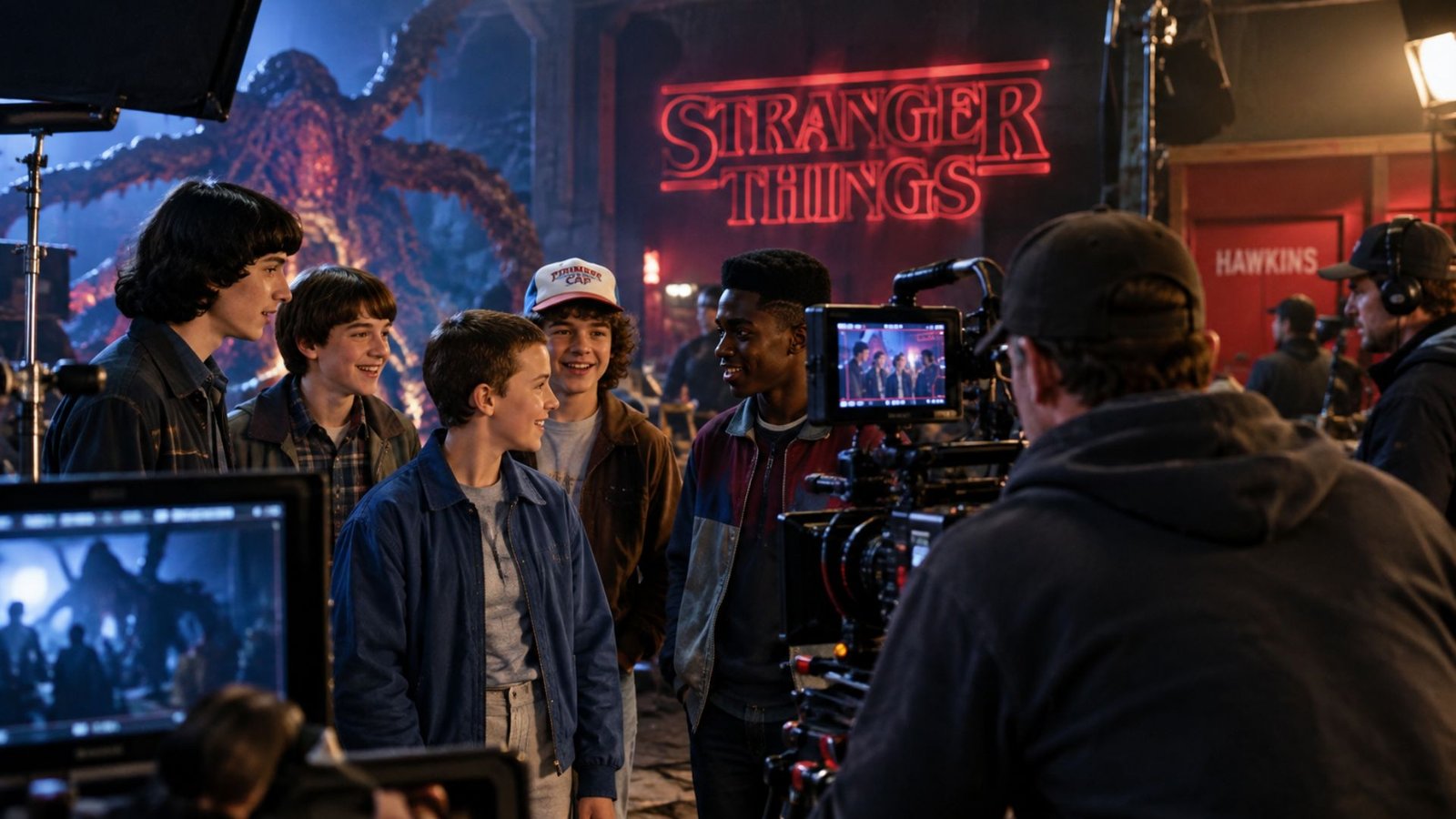
Stranger Things looks like a world built almost entirely from supernatural effects, but much of its visual identity comes from physical sets, costumes, makeup, stunts, practical creatures, and carefully planned camera work. The Stranger Things behind the scenes story is especially interesting because the production combines old-school filmmaking techniques with modern visual effects.
Netflix’s final season also received an unusually detailed making-of documentary, One Last Adventure: The Making of Stranger Things 5, giving fans a closer look at the cast, creators, writers, and crew.
What Makes Stranger Things So Difficult to Film?
The series has to make Hawkins, Indiana, feel like a believable small town while simultaneously creating the Upside Down, supernatural creatures, alternate dimensions, military facilities, and increasingly large action sequences.
That requires multiple departments to work together long before cameras roll. Production design establishes the physical environment, costume and makeup teams create the characters’ appearance, stunt teams plan dangerous movement, and visual-effects artists extend or transform what was filmed.
The Stranger Things behind the scenes process therefore isn’t simply about adding CGI after filming. The physical and digital elements are often designed together.
For Season 5, Netflix reported that production designer Chris Trujillo and his team developed some of the show’s largest sets, including WSQK radio station and the Military Access Control Zone.
Practical Effects Still Matter
One of the show’s most recognizable filmmaking choices is its use of practical elements alongside digital effects.
The Demogorgon provides a good example. In a Season 4 behind-the-scenes breakdown, the Duffer Brothers explained how practical effects, stunt performers, fire, camera movement, and visual effects were combined for the Russian prison sequence. The production even used a performer in a green suit in some shots before replacing or enhancing elements digitally.
That approach helps actors interact with something tangible rather than imagining every element against an empty screen. It can also give lighting and camera operators real objects to photograph, making the final composite feel more integrated.
The result is a production style that respects classic creature filmmaking while taking advantage of contemporary VFX.
How the Demogorgon Fight Was Built
The Russian prison fight demonstrates just how much preparation can hide behind a short action sequence.
The creators wanted the Demogorgon to feel physically present rather than appearing as a completely separate computer-generated character. Because the scene involved significant stunt work, the sequence was divided into several major stunt sections instead of attempting one uninterrupted take.
The stunt team rehearsed the choreography beforehand, while the filmmakers needed to know the creature’s approximate height and movement so David Harbour and the camera operators could perform the scene correctly.
That preparation is a major part of the Stranger Things behind the scenes craft. What appears spontaneous on screen is often the result of choreography, rehearsals, safety planning, lighting decisions, practical effects, and post-production working together.
Sets Make Hawkins Feel Real
The physical environments are another major reason the series feels immersive.
Rather than treating every location as a digital backdrop, the production has built substantial standing sets and repeatedly modified them as the story developed. The Wheeler house, for example, remained an important physical location over multiple seasons.
Season 5 pushed this approach even further. Netflix’s behind-the-scenes coverage describes extensive sets created for locations ranging from radio facilities to enormous supernatural environments.
READ ALSO :Last Samurai Standing Season 2: What We Know
| Production Element | What It Adds to the Show |
|---|---|
| Practical sets | Gives actors physical spaces to interact with |
| Makeup and prosthetics | Creates convincing creatures and character transformations |
| Stunt choreography | Makes action sequences physical and coordinated |
| Visual effects | Expands or transforms photographed environments |
| Costumes and hair | Establishes the 1980s setting and character identities |
| Production design | Connects Hawkins locations into a believable world |
Why the 1980s Look Requires So Much Work
The period setting is more than a collection of retro clothes and hairstyles.
Everyday details help establish the era, including cars, interiors, signage, technology, furniture, music-related imagery, and clothing. Costume and hair departments have to make characters look authentic to their age and circumstances while allowing their appearances to evolve with the story.
That attention to detail becomes even more noticeable in a show where ordinary suburban locations can suddenly become supernatural battlegrounds.
💡 Pro Tip:
When watching behind-the-scenes footage, focus on the edges of the frame. Production design details such as walls, props, lighting equipment, removable set pieces, and practical effects often reveal how much of a seemingly digital environment was actually constructed.
The Cast Grew Up With the Production
Another unusual part of the show’s production history is the long relationship between its young cast members.
Finn Wolfhard, Millie Bobby Brown, Gaten Matarazzo, Caleb McLaughlin, Noah Schnapp, and their fellow performers spent years working together as their characters and real lives changed. Netflix’s interviews around the final season repeatedly highlight how those long-term relationships influenced the emotional atmosphere of the final episodes.
For the final season, that history became part of the filmmaking story itself. The production ran for about a year, and the cast and crew were documenting the end of a decade-long project.
The Stranger Things behind the scenes material consequently captures more than technical filmmaking. It also records the end of a long-running creative partnership.
What the Season 5 Documentary Reveals
Fans who want the deepest look at production can watch One Last Adventure: The Making of Stranger Things 5 on Netflix.
The roughly two-hour documentary follows the Duffer Brothers, cast, and crew through the creation of the final season. Netflix describes it as an inside look at the years of work and craftsmanship involved in completing the series.
The documentary includes footage from the set and writers’ room, including an emotional final table read and the cast’s final filming days. It also provides insight into creative discussions surrounding major story decisions.
Netflix’s broader Season 5 behind-the-scenes coverage also explores production design, VFX, costumes, makeup, and hair, showing how many specialists contributed to the final version of Hawkins and its supernatural world.
Why the Behind-the-Scenes Material Matters
The most interesting lesson from the Stranger Things behind the scenes footage is that spectacle usually begins with practical planning.
A monster may ultimately contain extensive digital work, but the scene still needs choreography. A massive location may be enhanced digitally, but actors may begin inside a physical set. A supernatural transformation may depend on VFX, yet makeup, costumes, lighting, and performance establish the foundation.
That combination explains why the series can move between intimate character drama and enormous supernatural action without completely losing its physical sense of place.
📌 Key Takeaway:
The visual world of Stranger Things is built through collaboration. Practical sets, creature effects, makeup, costumes, stunts, cinematography, production design, and VFX are designed to support one another rather than function as isolated parts of the production.
Frequently Asked Questions
Where can I watch Stranger Things behind the scenes?
Netflix provides official behind-the-scenes videos and articles through Tudum, including interviews, production features, and footage from Season 5. One Last Adventure: The Making of Stranger Things 5 is also available on Netflix as a dedicated documentary about the final season.
Did Stranger Things use practical effects?
Yes. The production has used practical elements alongside digital visual effects. The Season 4 Demogorgon prison sequence, for example, combined stunt performers, practical fire, physical performance, and VFX to create the finished action scene.
How long did Stranger Things Season 5 take to film?
Netflix’s Season 5 coverage describes the production as a yearlong shoot. The extended schedule reflected the scale of the final season and the complexity of its sets, action, visual effects, and ensemble scenes.
Is there a Stranger Things Season 5 making-of documentary?
Yes. One Last Adventure: The Making of Stranger Things 5 is a documentary devoted to the creation of the final season. It includes behind-the-scenes footage from the production and writers’ room as well as moments involving the cast and creators.
Are the Stranger Things monsters completely CGI?
Not necessarily. The production has used a mixture of practical and digital techniques. The Demogorgon, for instance, involved practical performance and stunt work that was later combined with visual effects. This hybrid approach helps the creatures interact convincingly with actors and environments.
Conclusion
The appeal of Stranger Things behind the scenes comes from seeing how many different filmmaking disciplines are required to create a world that appears effortless on screen. Practical construction, creature work, stunt choreography, production design, costumes, makeup, cinematography, and VFX all contribute to the finished experience.
Season 5 made that collaborative process particularly visible through Netflix’s documentary coverage. For longtime fans, it offers a final look not only at how Hawkins was built, but also at the people who spent years bringing its story to life.

2 Comments
Pingback: The Founder: Where to Watch and What the Movie Really Means- 80s Fashion Style
Pingback: Lioness Cast: Season 1 and Season 2 Explained - 80s Fashion Style