

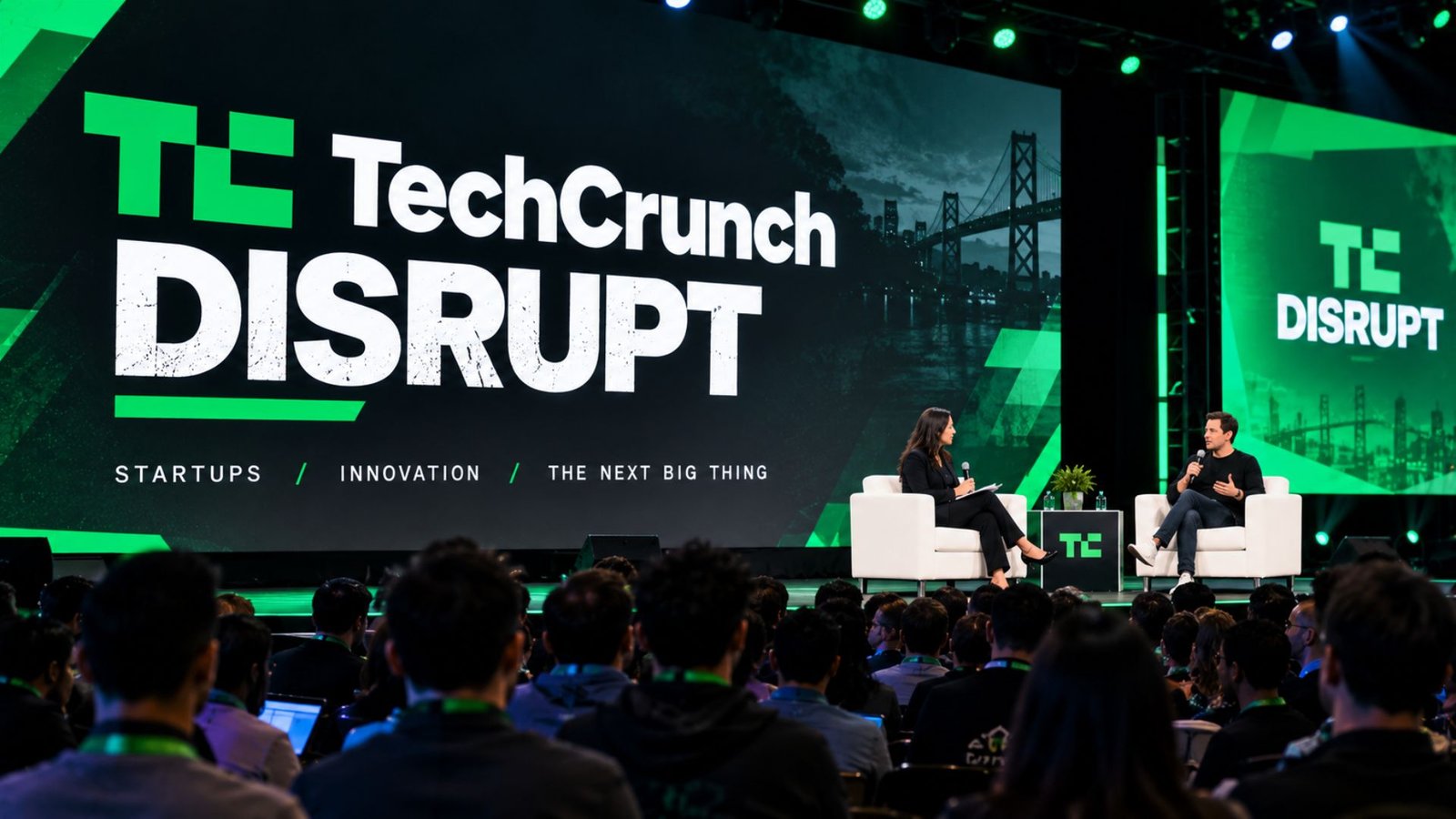
For founders, investors, developers, and technology professionals, attending a major startup conference can create a frustrating problem: there is simply too much happening at once. Multiple stages, hundreds of startups, investor meetings, product demonstrations, and networking opportunities can make it difficult to know where the real value is.
That is exactly why TechCrunch Disrupt 2025 attracted so much attention. Held October 27–29, 2025, at Moscone West in San Francisco, the event brought together startups, venture capital firms, technology executives, and entrepreneurs for three days of pitches, demonstrations, discussions, and networking. TechCrunch positioned the event as part of its 20th-anniversary year, with more than 10,000 technology and venture leaders expected to participate.
But the most useful way to understand Disrupt is not simply to look at its biggest speakers or the number of attendees. The interesting part is what the event revealed about early-stage technology: which problems founders are trying to solve, how investors question new companies, and what separates an interesting idea from a startup that can demonstrate a credible business.
Here is what happened at the event, what stood out, and what founders can learn from it.
What Is TechCrunch Disrupt?
TechCrunch Disrupt is a major startup and technology conference organized by TechCrunch. Its focus extends beyond keynote speeches: the event combines startup exhibitions, investor networking, educational sessions, product demonstrations, and the Startup Battlefield competition.
The 2025 edition took place at Moscone West in San Francisco from October 27 through October 29. It was particularly significant because TechCrunch was celebrating its 20th anniversary.
The event was designed around several different ways of participating:
- Startup exhibitions and demonstrations
- Investor and founder networking
- Main-stage technology discussions
- Founder-focused educational sessions
- Roundtables and breakout sessions
- Startup Battlefield
- Industry-specific conversations around AI, robotics, fintech, health, climate technology, cybersecurity, and other fields
That variety matters because Disrupt is not really one event. It is several different experiences happening simultaneously.
An investor may approach it as a sourcing opportunity. A founder may see it as a fundraising and exposure opportunity. A developer may focus on emerging technologies, while an aspiring entrepreneur may use it to understand how successful startups communicate their ideas.
What Happened at TechCrunch Disrupt 2025?
The 2025 conference featured more than 250 sessions and discussions, alongside a large exhibition area featuring hundreds of startups. TechCrunch reported more than 300 exhibiting startups during the first day.
The event’s biggest competitive component was the Startup Battlefield 200.
Thousands of startups applied, with 200 companies ultimately selected for the Startup Battlefield cohort. From those 200, 20 companies were chosen to compete directly on the Disrupt Stage.
The competition was structured around short pitches and live demonstrations. The finalists had to communicate their product, problem, market opportunity, and differentiation under considerable time pressure.
That format creates a useful lesson for anyone building a startup: a good product does not automatically make a good pitch.
A founder has to make the value understandable quickly.
Startup Battlefield 2025: The Winner
The winner of the 2025 Startup Battlefield was Glīd, a company focused on improving the movement of shipping containers between ships, rail infrastructure, and their eventual destinations.
Its technology combines hardware and software, including a hybrid-electric vehicle designed to move 20-foot shipping containers directly to rail without relying on conventional forklifts or hostler trucks.
Glīd competed against a strong group of finalists. The other four finalists were:
- Charter Space
- MacroCycle
- Nephrogen
- Unlisted Homes
The winner received the Startup Battlefield Cup and $100,000 in equity-free funding.
Nephrogen was selected as the runner-up. The biotech company is developing a specialized delivery system intended to transport gene-editing medicines to kidney cells.
Why Glīd’s win is interesting
One of the less obvious lessons from the competition is that the winning idea was not simply another consumer AI application.
Glīd addressed a highly specific operational problem inside global logistics.
That distinction is useful for founders watching startup trends. Innovation does not always mean inventing a completely new category. Sometimes the opportunity is hidden inside an inefficient process that has existed for years.
In practical terms, a founder evaluating a startup idea should ask:
- What expensive or slow process exists today?
- Who experiences the problem frequently?
- What does the current workaround cost?
- Can technology measurably improve that process?
- Can the improvement become a scalable business?
Those questions can reveal opportunities that are less obvious than simply building another generalized software product.
What Kind of Startups Appeared at Disrupt 2025?
The Startup Battlefield 200 covered a surprisingly broad range of industries.
TechCrunch identified startups working across areas including AI, climate technology, healthcare, fintech, robotics, consumer technology, cybersecurity, defense, mobility, and life sciences.
The Top 20 reflected that diversity.
Companies were working on problems involving:
- Healthcare and biotechnology
- Robotics and automation
- Climate and sustainability
- Logistics
- Cybersecurity
- Financial infrastructure
- Compliance
- Mobility
- Artificial intelligence
- Consumer technology
This diversity is significant because it challenges the idea that a startup conference is primarily about whatever technology is currently receiving the most attention.
AI remained an important theme, but the event also demonstrated that investors and founders continue to build around physical infrastructure, healthcare, industrial systems, and specialized enterprise problems.
The Main Stage Focused on More Than Startups
Another major part of TechCrunch Disrupt 2025 was the Disrupt Stage.
The speaker lineup included major technology and investment figures such as Alphabet moonshot chief Astro Teller, Microsoft CTO Kevin Scott, Netflix CTO Elizabeth Stone, Vinod Khosla, and Sequoia Capital’s Roelof Botha.
These discussions covered subjects ranging from artificial intelligence and venture capital to autonomous vehicles, technology platforms, and long-term innovation.
The practical value of these sessions was different from Startup Battlefield.
Battlefield showed what early-stage companies were building.
The main stage provided broader context about how established technology leaders and investors were thinking about the direction of the industry.
For someone attending a future technology conference, that distinction is worth remembering. You should not spend the entire day watching keynotes if your primary goal is meeting potential customers or investors.
The Builders Stage Was Particularly Practical
The Builders Stage focused on the less glamorous but arguably more useful side of entrepreneurship: actually building and scaling a company.
TechCrunch described sessions covering subjects such as obtaining a first term sheet, developing a go-to-market strategy, deciding where AI fits into a business, and scaling a company. Speakers included experienced founders, operators, and investors.
This reflects an important reality about startup building.
The product launch is usually the easy part to understand from the outside. The difficult work comes afterward.
Founders have to figure out:
- How to acquire customers
- How to price the product
- How to hire
- How to manage cash
- How to build repeatable sales
- How to respond to competitors
- How to decide which features not to build
- How to demonstrate traction to investors
Those operational questions are often more important to a company’s long-term survival than the pitch itself.
A Useful Lesson From the 200 Startups
One of the most overlooked details of TechCrunch Disrupt 2025 is that winning the main competition was not the only opportunity available to startups.
Two hundred companies were selected for Startup Battlefield. Only 20 advanced to the main-stage competition, and five ultimately became finalists.
That means 180 companies did not receive the same level of main-stage attention, but they were still part of a highly curated startup cohort.
This creates a valuable distinction between visibility and value.
A startup does not necessarily need to win a pitch competition to benefit from an event. An entrepreneur may receive more useful results from meeting three potential customers, finding a technical partner, or securing an investor introduction than from collecting a trophy.
For founders, this is an important way to measure conference ROI.
How Founders Could Get More From Disrupt
If you are considering attending a future TechCrunch event, preparation matters more than simply buying a ticket.
1. Define your objective before arriving
Do not arrive with the vague goal of “networking.”
Choose a measurable target.
For example:
- Meet 10 potential investors
- Find three enterprise customers
- Research five competing products
- Recruit a technical co-founder
- Study how successful founders pitch their products
A specific objective makes the conference much easier to navigate.
2. Research companies before the event
If hundreds of startups are exhibiting, walking randomly through the exhibition floor can consume hours.
Create a shortlist beforehand.
For each company, identify:
- What it sells
- Who its customer is
- What problem it solves
- Why it is different
- Whether you could become a customer, partner, investor, or competitor
Then approach the people who are actually relevant to your objective.
3. Pay attention to questions, not only pitches
This is one of the most useful ways to learn from Startup Battlefield.
The pitch tells you what the founder wants the audience to understand.
The judges’ questions reveal what experienced investors want to know before believing the story.
Pay particular attention to questions about:
- Customer acquisition
- Revenue
- Competition
- Market size
- Unit economics
- Defensibility
- Regulation
- Technical feasibility
Those questions can help founders identify weaknesses in their own business models.
Common Mistakes First-Time Attendees Make
A conference with thousands of people creates plenty of opportunities to waste time.
Some common mistakes include:
Trying to attend everything.
You cannot meaningfully absorb every session. Pick the discussions that directly support your objective.
Collecting contacts without context.
A pile of business cards or new LinkedIn connections is not the same as a useful relationship.
Pitching everyone.
Not every person is a customer or investor. Start conversations by understanding what the other person actually does.
Ignoring smaller sessions.
Large keynote sessions attract attention, but smaller discussions can create better opportunities for questions and conversations.
Failing to follow up.
The conference itself is only the beginning. The real value often comes from what happens during the weeks afterward.
Three Less-Obvious Insights From Disrupt 2025
Specialized problems can compete with headline technologies
The success of Glīd illustrates how a startup addressing a narrow industrial bottleneck can attract attention alongside companies working in AI, biotech, and other highly visible categories.
That suggests founders should not automatically chase the most fashionable technology category. A painful problem with a clear economic value can be a powerful starting point.
A short pitch exposes business-model weaknesses
The six-minute Startup Battlefield format forces founders to prioritize.
That is more useful than it might initially appear.
If a company cannot explain its customer, problem, product, and economic value quickly, the issue may not simply be presentation skills. The underlying business proposition may itself need clarification.
The event is also a market-research exercise
With hundreds of startups presenting products across different industries, Disrupt can function as a concentrated snapshot of entrepreneurial activity.
For founders, competitors, investors, and researchers, studying what companies are building can reveal where entrepreneurs believe customers are experiencing expensive or underserved problems.
That makes the event useful even for someone who never intends to compete in Startup Battlefield.
Is TechCrunch Disrupt Worth Paying Attention To?
The answer depends on what you want from a technology conference.
For founders, the value can come from investor conversations, customer discovery, competitive research, and learning how other entrepreneurs communicate their products.
For investors, the Startup Battlefield ecosystem provides a concentrated look at early-stage companies.
For technology professionals, the event offers exposure to emerging products and discussions about where major technology companies are investing their attention.
For students and aspiring founders, watching pitches can be an inexpensive way to study startup communication and product positioning.
The important point is to define the purpose before judging the value.
A person looking for technical education may have different priorities from an early-stage founder searching for investors. There is no single way to use an event like Disrupt effectively.
Frequently Asked Questions
What is TechCrunch Disrupt 2025?
TechCrunch Disrupt 2025 was TechCrunch’s flagship startup and technology conference held October 27–29, 2025, at Moscone West in San Francisco. The event brought together founders, investors, technology leaders, and startups through talks, networking, exhibitions, and startup competitions.
Who won TechCrunch Startup Battlefield 2025?
Glīd won Startup Battlefield at TechCrunch Disrupt 2025. The company focuses on improving the movement of shipping containers between ships and rail infrastructure using a combination of hardware and software. The company received the Startup Battlefield Cup and $100,000 in equity-free funding.
How many startups were selected for Startup Battlefield 200?
TechCrunch selected 200 startups from thousands of applications for the 2025 Startup Battlefield cohort. Twenty companies advanced to compete directly on the Disrupt Stage, with five eventually becoming finalists.
Where was TechCrunch Disrupt 2025 held?
TechCrunch Disrupt 2025 was held at Moscone West in San Francisco, California, from October 27 through October 29, 2025.
What can founders learn from TechCrunch Disrupt?
Founders can study how successful startups explain problems, demonstrate products, answer investor questions, and communicate their market opportunity. The event also provides practical lessons about fundraising, customer acquisition, networking, and scaling a business.
Conclusion
TechCrunch Disrupt 2025 was more than a three-day technology conference. It provided a concentrated view of what early-stage founders were building and what investors, operators, and technology leaders were discussing.
The Startup Battlefield competition offered the clearest example. Two hundred startups were selected from thousands of applicants, 20 reached the main competition, and Glīd ultimately took the top prize with a solution aimed at a very specific logistics problem.
Perhaps the biggest takeaway is that startup innovation does not have to look futuristic to be significant. Sometimes the strongest opportunity is hidden inside an inefficient process that businesses have tolerated for years.
For anyone following startups, AI, venture capital, or emerging technology, the most useful approach is to look beyond the headline speakers and winning company. Study the problems founders are solving, the questions investors ask, and the evidence companies use to prove that their products matter. That is where an event like Disrupt becomes genuinely useful.

1 Comment
Pingback: Encryption: How It Protects Your Data- 80s Fashion Style